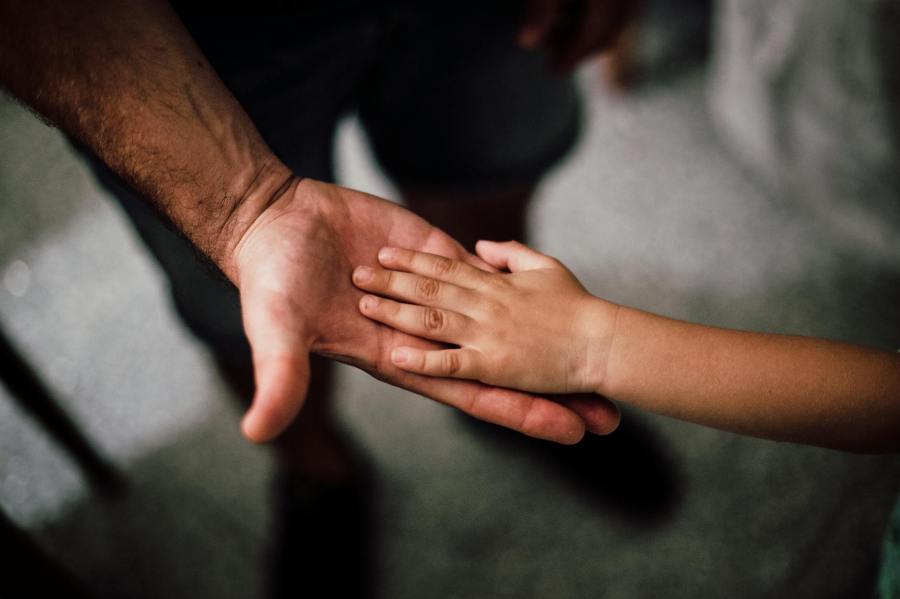
Hearing the prayer of a small child can melt your heart. It’s cute when children pray for their stuffed animals or for their little brother to stop misbehaving; it tugs on your heart strings when they pray for you or for those close to you. While it’s sweet and often moving to hear our children pray, in this article I hope to consider the “why” and “how” of prayer within in our homes and families, as well as offer practical advice about children and prayer.
Your children need to hear you pray.
Though it may be tempting to allow your children to say all the family prayers in your household or to return thanks before every family meal, let’s consider whether that truly is the wisest practice. Think about it like this: if your children are believers, they are immature believers at best, who have much to learn. They’re not only immature in the faith but also in life; therefore, they need to be taught how to pray, and one way we teach them is through our example. Our children need to hear our prayers to learn how to pray.
As parents we are called to bring up our children in the discipline and instruction of the Lord (Eph. 6:4), and we do this by teaching, explaining, encouraging, and modeling. When it comes to prayer, one way (and perhaps the most important way) we teach our children is by demonstrating for them how to pray. Since our children are either non-believers or immature believers, they need to hear their Christian parents pray in order to learn how they ought to pray.
Your children need your prayers.
Let’s say your children are not believers. Why would you allow a non-believer to be the primary intercessor for your family? I am not advocating an “all or nothing” approach when it comes to praying aloud on behalf of the family, but here is my question: if you and your spouse are believers and your children are not, who should be the primary intercessor for the family? The non-believing children or the believing parents?
God’s Word tells us that He hears the prayers of the righteous (Prv 15:29); thus, it makes biblical sense for those who have been declared righteous through faith in Christ to intercede on behalf of the family. Our children either need to be born again or they need to grow in maturity, neither of which they can do apart from the grace of God. Parents, I encourage you to plead with God that He will do a good work in the lives of your children and that He will bring that work to completion at the day of Jesus Christ (Phil 1:6). Your children need your prayers.
Your children need to be taught how to pray and what to pray for.
Since our children are inclined to pray for themselves or for self-serving purposes (I speak from experience here), they need to be instructed. One opportunity to instruct your children arises when you ask for prayer requests. This is a time to hear and know the cares of their hearts and to instruct them as well. For instance, when your child asks you to pray for their toys, you can use this as an opportunity to discuss giving thanks to God for all things, because all things ultimately come from Him.
Another way to help them understand what to pray for is by creating a prayer schedule or by developing a regular prayer routine. You might find it helpful to create a prayer calendar in which you pray for topics such as your family, your church, your neighbors, your nation, missionaries, etc. Our family’s regular routine is to pray for a different family from our church each evening at bedtime. Another way to teach them what to pray for is by using an acronym to guide your prayers, such as ACTS (adoration, confession, thanksgiving, supplication). Whether you utilize any of these ideas or not, I urge you to teach your children how to pray.
Conclusion
Children who grow up in Christian homes are either non-believers or immature believers at best, so we should not designate them as the primary intercessors on behalf of our families. This does not mean we should never invite them to pray, but we ought to consider that abdicating such a great responsibility in our homes is not a healthy practice. Asking or allowing our children to serve as the primary pray-ers in our homes can promote a child-centered home that prevents growth and maturity for everyone involved. In the church, we see an exhortation for older women to teach younger women and older men to teach younger men (Titus 2). Shouldn’t we employ a similar model in our homes and train up our children in all areas of life, including prayer?
We should teach our children to pray, and we should pray for them. If your children are not believers, do not expect their prayers to be effective (Jn 9:31; 1 Pt 3:12). If they are believers, we must still model for them how to pray. And as they mature, we can and should provide them with more opportunities to pray on behalf of the family, because God hears the prayers of those who have been declared righteous in Christ (Prv 15:29). Perhaps the best way we can teach our children to pray is by laying before them their wretched state along with the Gospel of grace. As John Bunyan notes: When their eyes are opened to their wretched condition and the hope of grace in Christ, then “their hearts will run out to God in prayer.” (Bunyan, Prayer. East Peoria, IL: The Banner of Truth Trust, [1662], 2012). Let’s urge them to run to Christ today, and let’s train them up in the Lord by teaching, explaining, encouraging, and modeling prayer within our homes.
 Proclaim His Name